Showing posts with label ARE316. Show all posts

Thursday, May 14, 2015

ARE316 FINAL


1. The most significant show and tell in my opinion was Hali's Coding Academy show and tell.  I have no experience whatsoever in coding and it was not really offered at my high school.  I feel as though this is something vital that we need to learn in this day and age and it helped me understand the idea of "digital literacy" better.  The sites Hali provided seemed fun and easy to use and I plan to explore them and try to learn from them over the summer.  I have seen so many of my former teachers assigned courses that they have no idea how to teach, so I hope that in becoming more fluent in digital literacy, I might be able to better prepare myself for anything to come.  I believe that it could be fun to try to do a coding project in the classroom and after exploring these sites more, I hope I will have a better understanding of the limitations of coding and the possibilities of what we can do with it.  I believe knowing how to code is necessary for children today and it is better for them to learn it earlier rather than later.  I wish that I was taught a little about it in my required computer science classes in middle school instead of merely learning how to type faster.

2. Two readings that I think were important to this course were Gill 2009 and Kellner & Share 2005.  In Gill's essay he wrote:  "Games Generation workers rarely even think of reading a manual.  They'll just play with the software, hitting every key if necessary, until they figure it out."  This quote really made me evaluate what I wanted my teaching style to be like.  I realized that my lessons were too instructional based and did not contain enough free thinking and exploration for students to discover solutions on their own.  It also made me look at my own life and my stubborn refusal to look at instructions or manuals when I try to fix things or put them back together.  I also have to say that I loved this reading's positive look at how video games effect children's digital literacy.  Everything in the news always seems to discuss how violent video games are and how violent our children are becoming as a result of this exposure.  For Gill to actually say that scholars believe video games skills and abilities can transfer to other computer skills, I couldn't be happier.  This brings me back to this idea of skill acquired knowledge that I want my future classrooms to based around instead of lectures and demos.  This reading inspired me to make my 3D prosthetic project based on a design I saw in Assassin's Creed.  I modeled my design off of the hidden blade worn by Ezio Auditore in AC2 because I liked the sturdy design and I thought that it had the potential to be a very sleek and elegant design.  I also thought that the arm attachment offered more control than a finger attachment and the user would be able to put more pressure on it that one tiny little finger.

The second reading, Kellner & Share 2005, was equally important in its message to us as future educators.  In the reading it said, "Further, a student-centered, bottom-up approach is necessary for a standpoint analysis to come from the student's own culture, knowledge, and experiences."  I have seen this concept in effect in this course since day one.  All of the projects were centered around us coming up with our own solutions and working off of our past experiences.  Most projects were left very open ended for this particular reason as well.  This course was not about a professor lecturing us for hours on end.  Instead it focused on the students and how we can improve as artists, students, and future educators.  I have always worked off of my own knowledge, culture and experiences in this course - as evident in all of my projects and designs.  As said previously, I designed my prosthetic based on my favorite video game and I also designed my 3D lesson plan (the 3D CO2 race cars) based on a lesson I was taught in my middle school woodshop class.  My videos featured my roommates and their phone/technology addictions, my love for oil pastels (which I use in the majority of my artwork), and an awesome Irish Dance video since that is the culture I most strongly connect to and identify with.  For my last project, I helped come up with the kiosk design - which was based off of my Girl Scout Silver Award project (2 posts down if you haven't read about it already) and my experiences as flier designer and PR person for my dance/art/music team, FOCUS.  My final lesson plan, as said in other posts as well, was created because of all of the problems I see in my own community and my desire to fix them.  I think that by using this student-based approach, it helped us become more engaged in the class and its curriculum and I cannot wait to create more projects, videos, and lesson plans like the ones I made in this class.  This reading stressed students' need to desconstruct media and learn how to create their own and I hope I have become better able to do so as a result of this course.


3.  I absolutely loved every project we did in this class, so it's impossible for me to pick a favorite.  I loved working collaboratively in a group and think of ways to improve campus life for the community.  I also enjoyed learning about and using 3D printers and I think they are the coolest things ever.  I hope to take a digital design and fabrication course in the future here just so I can learn more.  However, if I had to choose the most influential project, it would have to be the video cluster.  That project introduced me to the laid-back atmosphere in this class, which was the complete opposite of the graphic design course I took last semester.  That class had such specific instructions that when I first walked in this class, I felt lost.  I went from having no options and no say in the projects we did to having free reign in everything we did in this class.  The first project cluster helped me get used to this kind of class format again and helped me make decisions for myself instead of blindly following the instructor's suggestions and decisions.  The videos also made me realize how much talent the people on Youtube really have since it took so many tries for me to make the least awkward video possible.  I never knew it would be so hard to talk to a camera until I made my instructional 10 minute video.  Looking back, there are so many things I would have done differently in that and my documentary.  I would have made them more eye-catching and attention grabbing if I could.  I would also change the formats around so they told a story more clearly.  I follow a few teachers who make instructional art videos on youtube for their students and everyone else, and I watched AP Calculus and Chemistry videos religiously when preparing for my exams.  I found them to be a great help in bridging the gap between classroom learning and my time at home.  These videos are essential in today's society as a way to take learning outside of the classroom and make it a continuous project.  This skill is definitely one I should work on for the future as it could help me in my career and just my overall sense of confidence.  For being such a horrible instructional video, I never imagined it would get so many comments and views on youtube.   While my Irish dance video only has 82 views to date, my oil pastel tutorial has 1,069 views and 21 likes.  I even received one comment giving me advice on other brands of oil pastels to try.  I think this is a great way for artists to connect to one another and give each other support and advice, so I hope to use my channel more for these types of tutorials (and maybe a few dance videos) in the future.


One final update on my Tinkercad 3D printing prosthetic

I know I finished my Tinkercad project a long time ago, but I still want to give you one final update.  Since I have to move out of my room tomorrow, I'm afraid my final project is already at my house, probably in storage.  So sadly, all I can show you is my final design:
https://tinkercad.com/things/bwhxApZD3iR

As you can see, I made the base of the design taller to better accommodate pens and eventually, I got rid of the rods altogether since they weren't printing out properly.  Instead, I used metal rods of about the same size that I took from an old car set my brother had.  I attached it to my arm with velcro wraps that I bought in A.C.Moore and I took the spring from my pen and attached it to the switch.  Sadly, I still needed to make adjustments for it to work properly, but it printed out in this awesome bright red color, so I can't be too disappointed in the way it turned out.

I could have printed it out a final time, but instead of that, I asked my little brother, who's a high school junior, what he wanted me to print for him.  I showed him Thingiverse and eventually, after hours of looking, he decided he wanted this:

http://www.thingiverse.com/thing:22115

A Squirrel Guardian that he only picked because it had a cool name and he hoped it would bring him luck on his AP exams.  So despite my confusion, I printed it anyway.  Surprisingly, it turned out far better than I could have possibly imagined.  We had it printed in his favorite color: blue, and it stands at about 3 inches high.  Here's a picture of the finished product- the perfect guardian squirrel:


Lesson Plan Possibilities- Turning Plans into Realities

So I've been thinking about ways my lesson plan described previously could extend outward and actually effect the community and I think I've found a possible solution.  I think that since it is supposed to be taught at the high school level, it would be a perfect way to get any boy scouts or girl scouts to start thinking about their Eagle Project/Gold/Silver Award Projects.  Sadly, I never received my Gold Award due to some unforeseen circumstances in my troop during my senior year, but I did manage to get my silver and bronze awards.   For my silver award project, my troop and I updated and redesigned part of Bower Park:
http://pleasantvalley-ny.gov/community/parks/bower-park/


I was responsible for mapping out the entire park and trails and the rest of my troop made trail signs and a kiosk for the map and information about the trails.  I lived near this park for years and never even knew it existed until we started this project.  It helped me look at my community with a more critical eye of how we can make the most out of what we already have.  The park when we first visited was spacious enough and had plenty of trails, but they were hard to follow and left hikers confused on what direction to go.  After plenty of town hall meetings and setbacks, we were finally able to make our vision a reality and our project brought attention to the park.  Though it is highly unlikely my student's projects will ever come to fruition, I still want to open up the conversation of how to make the community better and maybe someday, we can make that happen.


Lesson Plan Background

So today I posted my final lesson plan for the class (Hooray!) For my lesson, I decided to do a 3D digital design project in which students choose a space within their community they think needs improvements and then redesign it to better serve their community.

My initial inspiration for this project came from a recent trip back home (30 minutes away).  I went to the Poughkeepsie Galleria and then went to the Christmas Tree Shop in the South Hills Mall Plaza.  I have so many fond memories of the South Hills Mall, but now it resembles something closer to a ghost town.  The parking lot for it is almost as big as the mall itself, yet there are lots that have not been filled in 10 years or more.  Whenever I visit the plaza, I always think of what that parking lot could be changed into - like a park or a garden for the community.  I think of the same thing when I pass this one site on my way home from Red Oaks Mill.  It used to be a lawn and garden center, like Adams, and every Christmas they would put a giant inflatable snowman on top of the roof so you could see it from the road as you passed by.  It's probably been abandoned for at least 10 years now and through the years, I've watched the building collapse and all of the other businesses in that area seemed to disappear along with it. The overgrown lot is still for sale, but no one wants it.  I would love to see something done with it and I believe this is a growing problem in cities around the world, not just here.

Sunday, May 10, 2015

Finally Wrapping Things Up

I'm so glad to be finally done with that group project!  I wish we did it earlier in the semester, but my group managed to finish strong and come up with a great idea and a fantastic presentation.  I also have to say that I grew to like my role in the project as well.  I started out thinking Research Director was just a filler role with little importance, but I think the work I did really helped shape our project.  I experimented with the kiosk in the welcome center to get an idea of how it worked, and that changed our orientation of the Corkboard from a vertical plane to an inclined one.  I also did my own "user testing" experiments on my roommates.  They gave me a lot of useful feedback, but were mainly disappointed that the project was not intended for actual use.  Looking around now, I really do wish we could have something, if not a kiosk than at least an app to tell us what's going on.  I passed two concerts/festivals at my school in the past week and not one of my friends knew about them ahead of time.
As the PR person and newly elected Art Coordinator of FOCUS (my awesome club), I realize the difficulty in advertising for an event.  I designed the FOCUS posters seen across campus and tried to make them as eye-catching and colorful as possible.  Sadly, as seen in our video presentation, that was not enough to make them noticeable.  The wind kept blowing and tearing our fliers and it curled them up so no one could read them.  Also, some sorority kept putting their fliers over ours.  Our app/kiosk would stop those incidents and interferences from happening altogether, which is why I believe it is so necessary.  My team ended up going door to door handing out fliers and we even stood outside of Oscars the night before our show to pass out more.  Luckily, our show was a success and it had a great turnout, but think of how easy it would have been if we could just send a jpeg to the SA and they could put it up on the Corkboard.  An app/kiosk like that would make our lives so much easier, and I could focus on making the flier look pretty instead of trying to jam as much information as possible on it.

Overall, I'm glad that this was our final project.  I liked working in a group and I am so thankful I was put in an excellent group with amazing people.  I am generally a quiet person, so I'm glad I wasn't paired with someone loud and bossy who would drown out me and my ideas.  I did try to speak up more with this project and I think that became easier as I got to know everyone in the group.  This was a great opportunity to see how the graphic design BFA students work and I loved seeing how they could push our ideas into physical designs.

Monday, April 27, 2015

Videofreex Curator Experience

I just helped curate the Dorsky's Videofreex exhibit last Thursday with two other students from my class.  We were in charge of collecting and reviewing video submissions for the "Elements" theme of the week.  A few important questions were raised during our time down in the museum.  For one thing, are we as curators actively deciding what should and should not go into the exhibit?  If the video meets all other guidelines, who are we to question the artist's message and say it doesn't fit the theme or our narrow definition of what art is?

We came across one video in particular that caused a lot of discussion.  It was a video of a male and female student sitting on a bed.  There were large reflective balls of various sizes in the background and the boy was wearing a bandana covering his mouth and nose.  The girl was holding a cat and the boy was talking to it and stroking it with what we believe was a fake dagger or knife.  At first, the video started out okay, he was just waving the knife in the air.  The others questioned if it fit the theme, but again, who are we to argue with their vision?  What if the mirrored balls symbolized water and the boy's personality was the fire aspect of the video?  That was my original plan for my own elements video - to have different dancers and dances represent different elements in their speed and personality. I was ready to put the video into the exhibit, but then we saw the boy press the dagger to the cat's neck.  Immediately, we deleted the video and took it off of the list of accepted entries.  As soon as the video suggested cruelty to animals, or just cruelty in general, I think the curator does have the ability to step in and take it out.  Of course, the artist could have created a provocative video intended to shock the audience, but I feel as if this was not the case.  I think this experience was very helpful and let us engage in a dialogue about the curator's role and how much power they should be allowed to have.  This also relates to the material we just covered in my Art of the Later 20th Century class.  We just had a lesson on Fred Wilson and discussed the artist as a curator.  Essentially, it's the same as what we did for this class.  Instead of using art/sculptures/tools made by others, we also have our own creations submitted for the exhibit.  This creates a bias towards videos created by people in our own class as those automatically get added to the exhibit with little critique or questioning.  If that video had been a submission from our own class, there's a good change it would have been included, or at least considered more.  Just something to think about next time I have the power to decide what counts as art and what should be included in a exhibit open to the community. 

Sunday, April 26, 2015

Kickstarter Research

Just found a very interesting kickstarter project that fits well with the class curriculum.  It's a delta 3D printer called Tiko that's cheap ($179 per unit) and unibody.  This means that it is easy to assemble, manufacture, and according to the website, almost impossible to misalign.

https://www.kickstarter.com/projects/tiko3d/tiko-the-unibody-3d-printer?ref=category_popular

I looked at their kickstarter video to see what they did and how it can help my group with our video presentation.  For one thing, it's short and to the point at only one minute and forty-nine seconds.  It starts off by introducing their team of innovators and then it gets into how regular 3D printers are faulty, time consuming, and fall short of our expectations.  They used words like "heavy," "overcomplicated," and "unreliable" and put the words on the screen to emphasize their point.  Then they introduced their design as the answer to all of our problems showing a video of it in the process of printing out an object.  Next, they compared other printer frames with multiple pieces to unsteady lego sets.  Once they got the comparison out of the way, they went into specifics about the printer, like automated shut off, wireless connectivity, cloud-based software, the max volume it can print and other special features.   At the end of the video, they sum up their goals of having everyone be able to own a 3D printer and say that's why they kept the price so low.  The commercial ends with "Imagine what you could build. Back us today and let's find out."

I think this commercial set up could definitely work with my group's project proposal.  We're designing an interactive kiosk that could replace bulletin boards on campus.  I agree we should start the video by stating the problem.  We could show pictures that I took of the either too cluttered or too empty boards around campus and maybe throw in some statistics from my poll.  After that, we should offer up our solution to the problem and then go into details about what it can do.  I'm worried the design students in my group are trying to make the video more complicated than it needs to be, but we'll see.  I wanted to make a website, but can't really argue with them since it's their part of the project and they're the ones with the digital skills.  I'm hoping my group can come to some sort of agreement on the video tomorrow (Monday) and hopefully start storyboarding so we're ready to film on Thursday.

Thursday, April 16, 2015

Update on 3D printed prosthetic

So here's the updated version of my original Tinkercad design:

https://www.tinkercad.com/things/bwhxApZD3iR-3d-hidden-blade-prosthetic-revised/edit

I went in and remeasured everything, making the base a little higher and longer so pens can fit in it.  I also changed the size of the horseshoes since before they were too small to print and made them bigger.  I decided not to print out the rod altogether, instead borrowing the metal rod to one of my brother's old car sets.  I also went to Michaels and bought some Velcro that's smaller than the bands I was originally going to use.  As a result, I had to change the hole sizes in my actual base design and at this point, I'm just hoping everything fits together.  I have an hour until class and the 3D printing lab just sent me an email saying that I can come pick up my design.  Let's hope everything actually fits together and works this time (fingers crossed).

I'll put out another update once I have my design completed, put together, and hopefully working.

Sculptris Design


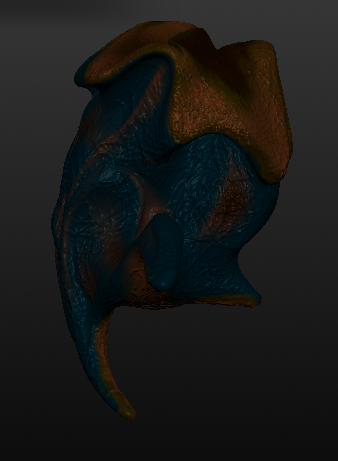
So here's my final Sculptris design.  Funny enough, I spent forever trying to make a head, then I got frustrated so I took the grab tool (which I hadn't used before) and I just slashed it through the guy's head.  It formed these cool tentacle things, so I made more of them and turned my original design into an octopus/squid thing.  I used the paint bump tool and a tiny brush size to make the bumpy texture that covers the thing's body.


Tuesday, April 7, 2015

DIY Prosthetic Project


So for my next project,  I am in the process of creating a 3D printed DIY prosthetic. After drawing  with my feet and mouth for my Spring break homework, I realized how vital control and pressure are to prosthesis designed to help amputees produce art.  I also realized that working with ones' arm is the most logical solution because it would still possess some fine motor skills even if the hand or some fingers were missing.

When designing, you have to think about the universality of your design.  Are you making an attachment for an already existing prosthetic?  Will your design only work with one specific pen/paintbrush/etc., and how can you generalize your design?  Since I decided to create a prosthetic that could hold a pen or pencil, I knew I would have to create a very general design that could fit multiple brands.  My design also had to give the user easy access to the drawing tools so they could quickly replace them.   I decided to make a device that attached to the wrist that way it was useable no matter how many fingers the person had.


 My design was loosely inspired by the hidden blade seen in Assassin's Creed.  For my research, on top of making cardboard models, I also watched tons of Youtube videos on hidden blade construction.  Initially, I wanted to make a spring loaded design that would make a pen or pencil pop out, but later I simplified it to just a pen/pencil holder.


cardboard model

I built my design on Tinkercad off of a hidden blade design I found on Thingiverse called "Hidden Blade!" by Theprintrbotmaker.  Here's what it looks like at the moment:


I just printed out my initial Tinkercad design and am now in the process of making adjustments.   I'm going to attach it to my arm with Velcro and the small tab on the back will (hopefully) be able to hold the pen in place as I apply pressure to it while drawing.  The top of the device (the thing with the orange hole) will slide across the top of the device and I will glue it into place.  I took a spring out of a click pen and will use that to hold the tab in place.  Then, when the pen dies, the person just needs to press on the tab, lifting it from its previous position of blocking the hole and allowing the pen to slide out.


Right now, a lot of the parts I created are too small to print out properly, so I'm in the process of making them bigger and trying to get the back to actually work.


Monday, March 23, 2015

Spring Break Challenge

So for my next project which focuses on creating DIY prosthetics using a 3D printer, I decided to challenge myself to create a drawing without using my arms.  Instead, I used my feet and occasionally my mouth to hold a pen to draw a picture.  What I discovered during my research was that my feet cramp fairly easily which makes it hard for me to draw for long periods of time without becoming fatigued.  Also, it was very difficult to vary different kinds of pressure and lines.  It was almost impossible to make straight or accurate lines as well.  Another issue I had was how to sit and work on the drawing.  I found that clamping it onto a drawing pad made the process much easier and propping it up with pillows while I was seated on the couch was easier than working on the floor.  I also found it interesting that one foot was not easier to work with than the other, so I was able to switch off easily.  Though my drawing is incomplete, it still took hours and hours to do.  Overall, this was definitely more challenging than I thought it would be and if I had to do this over again, I probably would have picked an easier material to work with, like oil pastels, and I also would have worked larger so the little mistakes and inconsistencies wouldn't show up as much.


Saturday, March 14, 2015

One awesome video and two mediocre ones

Here are my completed videos for my class' first project cluster.  I'm so relieved that they are all finally done!

This is my awesome Irish Dance video complete with explosions from DatMrRyan's channel:

This is my documentary on media addiction:


And last but not least, this is my awkward attempt at an oil pastel demo.  Enjoy!


Thursday, March 5, 2015

My Process

Just a few of my pages researching ideas for the video projects.  Here you can see the mess that is my thinking process and my attempt at storyboarding the documentary.  Most of these pages are just research for the Elements video - different dance steps, dubstep music, etc.  


Elements Update and how Pinterest ruined everything

So I mentioned in the last post that I wanted to use an awesome dubstep song in my video and make it a remix of different Irish step dancers who represent each element.

Well now I have a different idea so I'm scrapping all of that.  I think the main reason behind the switch would have to be my obsession with Pinterest.  I got so caught up pinning tons of different dancers and song ideas that I felt lost in the project.  I felt like I was just an editor and not a creator of a video, so I wanted to take the project in a more personal direction.

For myself that meant me dancing, even though I am extremely self-conscious and shy, and to make it even more challenging, it will be an acapella piece (like this one).  Irish step Hard Shoe isn't my forte, as I have a lot of trouble getting a firm and steady set of taps and bangs.  I think due to the loud nature of the filming, I will do it in Smiley, that way the residents of my dorm don't kill me.  I could also play with the lighting more in Smiley, especially if I bring my own lamp and film in the night.

The most challenging part of the process for me will be layering since I have almost no experience using iMovie outside of my class.  I want different dance steps to go with different elements and I think if I repeat and layer them, I could get a nice rhythm going.  One of the biggest inspirations for me at this stage is the first Irish step dance song I ever heard - Riverdance's "Reel Around the Sun":


Elements Dubstep Initial Idea

Now that my documentary is finishing up (Connected Documentary)
I thought I might start working on my Elements VideofreeX project.  My original idea for this video was inspired by Lindsey Stirling's "Elements" music video and TapTronic's many Irish step/dubstep dance videos.


Since we had a discussion about copyright and free use, I got permission from AP3HAUS on youtube to use his Gaelic Storm Dubstep video.  I also decided early on that I wanted to remix different youtube dance videos and put them in my project.  For example, this one girl I found definitely looks like she's dancing on AIR, while this next guy's performance is more grounded and powerful, making me think of FIRE.  I think a compilation of dancers would be make a cool video, especially after discovering this fan-made video featuring Lindsey and TapTronic together:


Instructional Video Project Research

While I'm working on my documentary project, I have also been thinking about my instructional video that has to be under 10 minutes long.  Right now I am leaning towards making it on art, specifically working with oil pastels since I've heard a lot of negative criticism of them from professors at school.  I have been watching and critiquing videos to see how others approach this topic.

Recently I found this video on youtube:


Though it was a somewhat decent tutorial, there were several things wrong with the video.  One of the most distracting elements of the video for me was the setting.  You can hear airplanes, birds and wind which all distract from the artist's voice.  He also filmed under a tree, so the sun hitting the paper also causes a distraction since it is constantly moving around.  Overall, I give the artist a lot of credit for having such smooth blending with cray-pas oil pastels which are cheaply made and hard to work with.

I think my documentary will be broken up into different sections and I will have more vocabulary words/descriptions on screen.  I have a lot of different brands of oil pastel, so I might talk about differences between brands as well.  I find that a lot of the time, teachers dismiss them because they think I will use a cheap, waxy pastel that will look terrible.

Tuesday, February 3, 2015

Watching Movies (As Research)

So I've been researching documentaries for my upcoming project, and by researching, I mean watching a LOT of videos (my netflix account is expiring soon).  Here are some, just to name a few:

Secrets: The Turin Shroud
Mystery Files: Pope Joan
Ancients Behaving Badly: Caligula
Ancients Behaving Badly: Cleopatra
Ancients Behaving Badly: Nero
The Most Evil Men in History: Caligula
Discovery: Royal Deaths and Diseases
Nat. Geo.: Finding Anastasia

Out of all of these, The Ancients Behaving Badly series was probably my favorite, just because of the graphic animations it included.  It has a feeling of nostalgia about it since the animation style is similar to the one used in "Blackwater Gospel".  (I used that video as inspiration for my rotoscope design last year for my Design Color class.)  Here's the video for reference, it's creepy, but beautifully put together:


In the Ancients Behaving Badly series, I liked how they put the subject of their documentary on a scale to compare his/her behavior to other famous psychopathic killers and rulers from history.  I found it much more enjoyable than the other documentary on Caligula that I watched, which included too many shots of statues and did not give the viewer a sense of his environment like the Ancients series did.  In that series, the reporter actually visited the ruins of the palace Caligula was held captive in and we get to see the underground passageways he took right before he was murdered.  Granted, the two documentaries were meant to serve different purposes.  The Most Evil Men in History was created to be a brief summary of Caligula's life and the atrocities he committed.  The Ancients Behaving Badly documentary, on the other hand, provided an in depth look at evidence implying Caligula's mental health and possible causes of his madness.  All in all, I think I have to do some more research before choosing a topic for my documentary.

Thursday, January 22, 2015

Intro to ARE 316

I took graphic design last semester, so I understand a little about Illustrator, how to make a rotoscope, and I love anything to do with video games.  I usually play on my PC, but also use Wii, WiiU, 3DS, and older consoles like Gamecube and Nintendo64.
I am currently scared of using Apple Computers, Photoshop, Indesign, and just audio editing in general.  Photoshop and Indesign were a part of the curriculum last semester for me, but I basically learned nothing about them.  Since I use a PC laptop at home, I don't like working with Macs in general.

The Struggle

An example of Rotoscoping: